How to Win Friends and Influence People by Dale Carnegie

Notable quotes:

  • “The reason why rivers and seas receive the homage of a hundred mountain streams is that they keep below them. Thus they are able to reign over all the mountain streams. so the sage, wishing to be above men, putteth himself below them; wishing to be before them, he putteth himself behind them. Thus, though his place be above men, they do not feel his weight; though his place be before them, they do not count it as an injury” Lao Tzu
    • The first line may be interpreted should we want others to respect us, we must respect them first, alternatively, if we want others to consider our thoughts then we must consider their thoughts first
    • The second line may be interpreted as a reiteration of the first line which is if we want others to respect us, then respect must come from the individual first
    • The third line may be interpreted as should an individual’s position be respected amongst the people they are with, those people wouldn’t be aware of how much respect was given to said individual. The respected individual’s earned respect does not threaten the people’s own positions in relations to the individual’s, as a result, the given respect is something people would not doubt to be given in the first place.
  • Context: on showing others kindness, tolerance, and patience as “[We] are god[s] in the chrysalis”
    • Regardless of your religious background (of which isn’t the point of this statement, anyways), the symbolism of god means that we have the potential to act as a moral authority figure similar to God when we are able to show others kindness even in situations that cause anger to arise in ourselves
  • A story that contains a lesson: “There are two weathers present in the sky. One of wind, the other the sun. An elderly man walking in a park wore a thick coat around him. The Wind makes a bet with the Sun, saying, “I bet I can blow the coat off this gentleman!” The Sun agrees to the bet, so the Sun goes behind the cloud to give Wind a turn. The Wind created strong, battering, waves of wind that turn into a tornado. The man pulled the coat even tighter around himself! The Wind gave up. The Sun, however, in their turn came out from behind the clouds and smiled warmly down upon the man. The rays of sunlight washes across the man’s face after having been bitten by the ferocious wind. The man found himself dabbing at his forehead with a piece of tissue paper, finding himself growing warmer and warmer. He eventually takes off his coat because it has become too warm, and continues on his walk”.
    • The lesson that is relevant in this story was shown to be through “force and fury” you would achieve resistance or rejection from what you seek. To achieve the result you’d like then a more gentle, and gradual process might be better.
Microsoft and Bethesda

https://www.npr.org/2020/09/21/915308028/microsoft-to-buy-bethesda-in-7-5-billion-deal-acquiring-fallout-the-elder-scroll

In the process of acquiring Bethesda–Microsoft also plans on adding Bethesda games to a cloud gaming service (Microsoft’s Xbox game pass).

First, what is the cloud? Second, what is cloud gaming? Third, what does this mean for people who play video games on the cloud?

First, the cloud are servers that are accessed over the internet.

Second, cloud gaming can be understood as video games that can be played on the internet and then be streamed to the user’s device.

Third, users that game on the cloud could use lower-powered, more energy-efficient devices at home and reduce their garbage that goes to the landfill every other time a new console comes out.

A.I. and COVID-19

If you can take a guess as to why I’m busy, maybe this summary I wrote for my biology 101 class will give you some sort of insight in my life.

The Humanity in Artificial Intelligence during COVID-19

The goal of the take-home project would be to summarize current scientific research relating to COVID-19, and the format that the summary is in would be as a news article; https://www.cnbc.com/2020/03/03/bluedot-used-artificial-intelligence-to-predict-coronavirus-spread.html.

The article “How This Canadian Start-Up Spotted Coronavirus Before Everyone Else Knew About It” by Cory Stieg explains how artificial intelligence platform, BlueDot, was able to understand data of “unusual pneumonia” occurring around a market in Wuhan, China. The “unusual pneumonia” was COVID-19, and the data was interpreted nine days before the World Health Organization released their statement of the novel coronavirus to the public.

Kamran Khan, founder and CEO of BlueDot and professor of medicine and public health at the University of Toronto had his experience as an epidemiologist and physician treating patients in Toronto during the severe acute respiratory syndrome (SARS) outbreak in 2003 that inspired him to start BlueDot. “What I learned during SARS is, let’s not get caught flatfooted, let’s anticipate rather than react,” Khan says.

BlueDot has a diverse team of 40 people including veterinarians, doctors, epidemiologists, engineers, data scientists and software developers that work with BlueDot’s proprietary software-as-a-service designed to track, locate and conceptualize infectious disease spread. Bluedot uses big data, and utilizes natural language processing and machine learning in order to look through data from official public health organizations, digital media, global airline ticketing data, etc. Then sends out alerts of atypical disease outbreaks that its AI have discovered and associated risks with the disease to health care, government, business, and public health clients. Afterwards, a group of physicians and computer programmers review the AI findings and create the reports that are sent out.

Overall, Kamran Khan, founder and CEO of the artificial intelligence platform, BlueDot, and a 40-person team manages the software in order to track data through various sources (i.e., public health organizations, digital media, global airline ticketing data, etc) then sends synopses to health care, government, business, and public health clients. A relevant quote to summarize this article would be, “teamwork makes the dream work”. Times such as these security becomes ever more important because as individuals we can experience difficulty in satisfying others needs and wants, and even face difficulty expressing our own needs and wants during these unpredictable times. Maintaining connections, having sensitivity to people’s circumstances, and having sensitivity our own circumstances become a necessary way to live and survive now ever since the outbreak.

We must come together as a team to live and survive.

BC Game Jam 2020, and Systemshacks 2020

Life Hacks

Life Hacks is all about increasing productivity and efficiency, in all walks of life. Participants have 12-hours to create a product that makes everyday life more convenient. They can create web applications, mobile applications, hardware hacks and much more

  • My team:
    • Systems software engineer at Simon Fraser University
    • First year computing science student at Simon Fraser University
    • Myself (at the time, a first year computing science student)
  • What I learnt:
    • Learn more programming languages
      • Here’s why: the difficulty of collaborating with others who have previously learnt other languages could have been avoided if I were to learn the languages that they were personally proficient in
    • Persevere
      • Here’s why: coding for twelve hours straight isn’t a walk in the park. You need to get up every twenty five minutes in order to maintain proper blood flow, and get enough breaks so you’re able to deliver consistent quality in your work. People also leave half way through the event when faced with conflict, so take it slow
        • As they say, “the tortoise overtakes the hare”
    • Allow judges to demo the product
      • Here’s why: it’s better to show how your product works then it is to tell people how your product works
  • What I experienced:
    • My first hackathon!

BC Game Jam 2020

The game development clubs from BCIT, UBC and Simon Fraser University band together to form BUS, the ultimate student game development coalition that will bring you an awesome, affordable game jam experience!

My team:

  • Reincarnationz (Jay Mok), artist
  • Myself (at the time, a first year computing science student)

What I learnt:

  • Making a visual graphic novel by yourself between 6pm to 10pm for three days while getting adequate sleep is harder than it sounds

What I experienced:

  • Making a lot of friends

Getting Code Club Into BC Elementary Schools

At night, leave the lights off as you enter your bathroom. Shut the door behind you, and stare into the mirror.

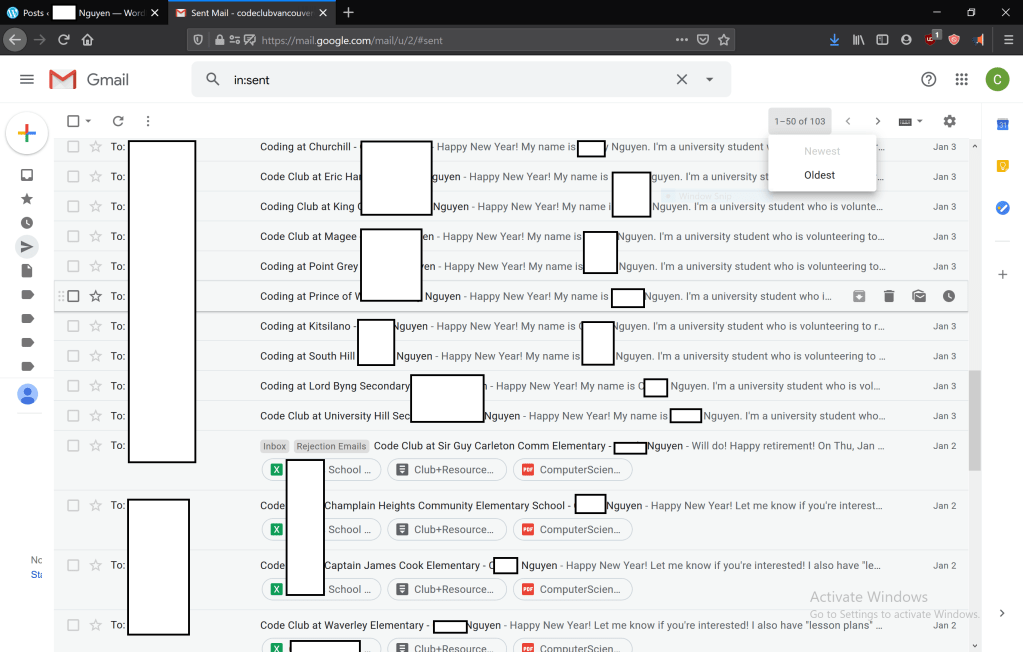
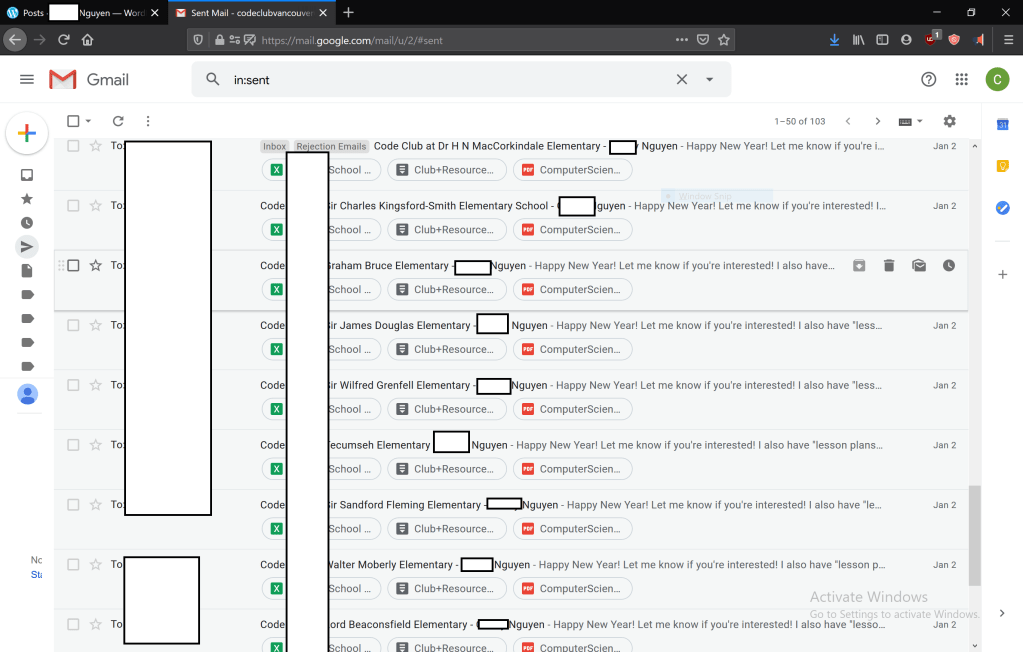
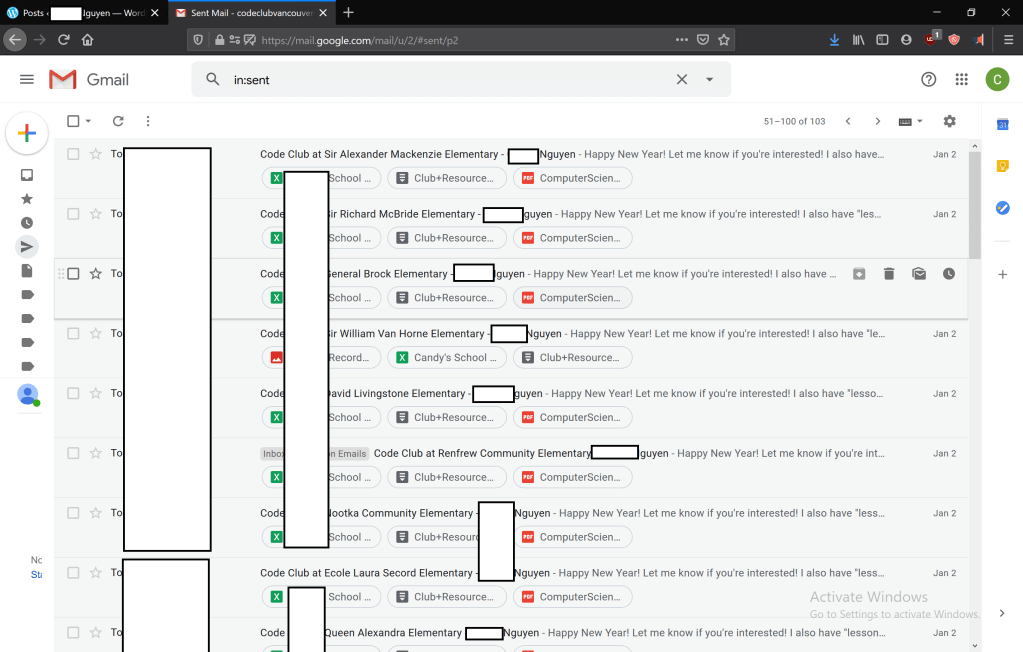
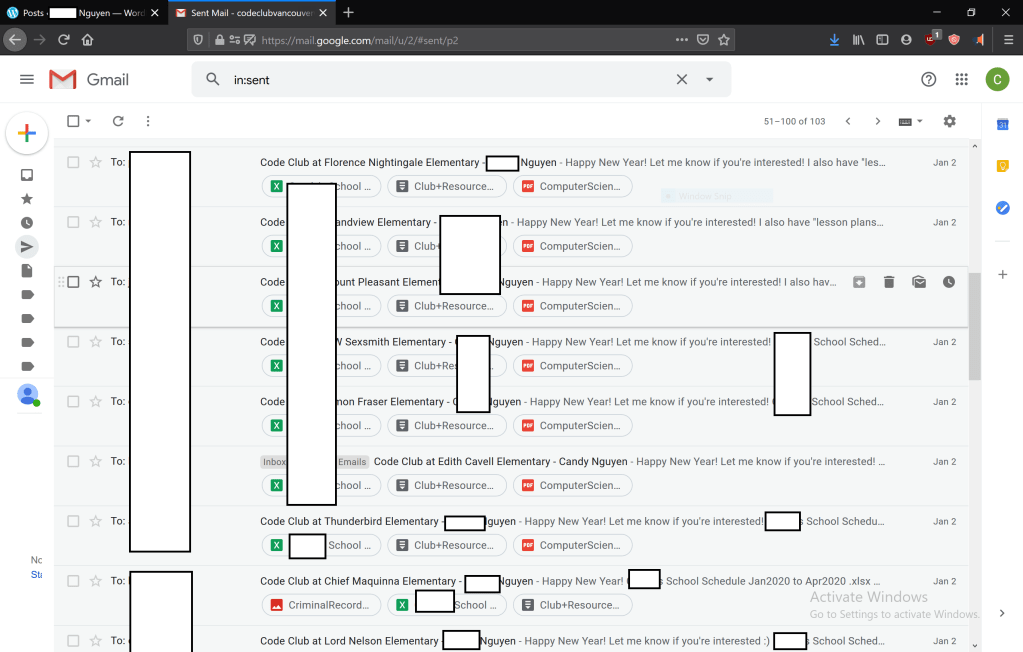
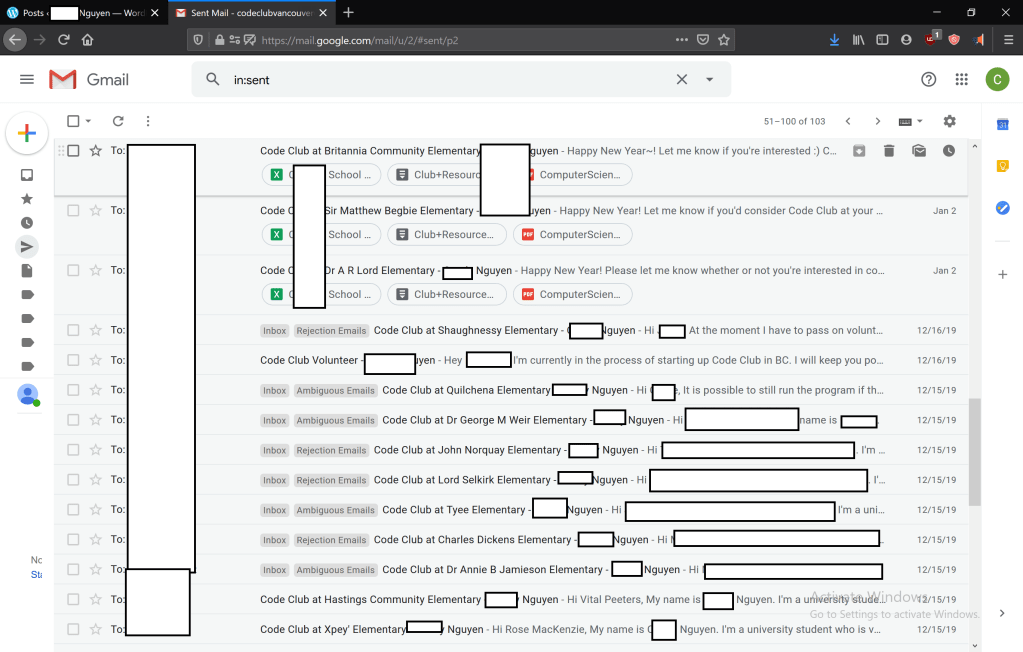
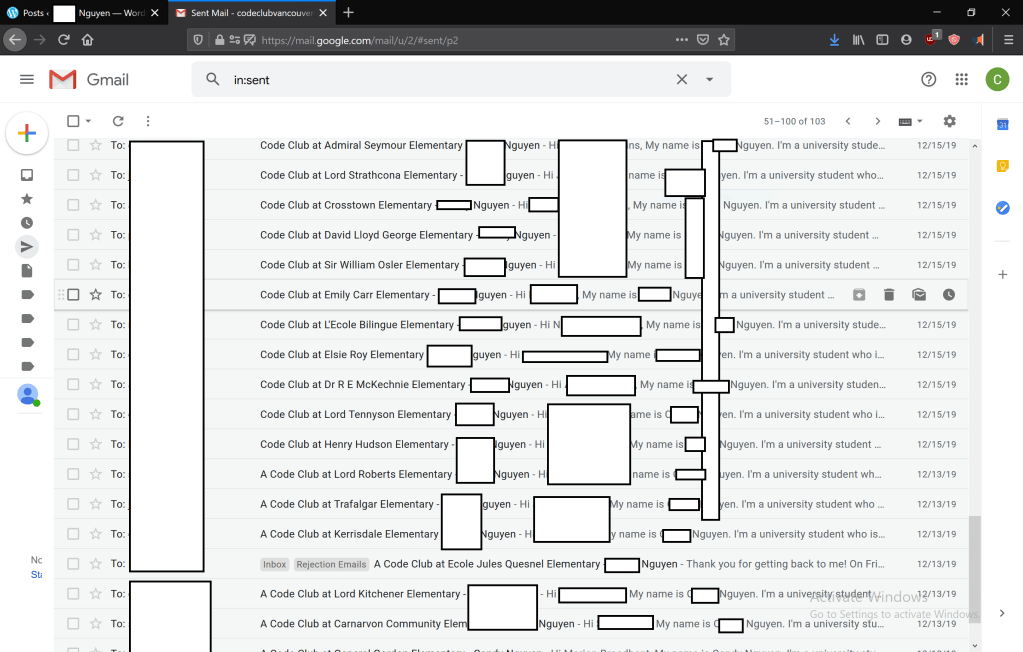
If you say “Nguyen” three times in the mirror, spin on the spot, and draw a star on the glass of the mirror…it is said that an email will be sent asking whether or not your institution would be interested in having a coding club for the student body from a particular Nguyen.

Machine Learning: Living in the Age of AI | A WIRED Film

Watch here; https://www.youtube.com/watch?v=ZJixNvx9BAc

  • Gerry is a seventy year old man that has more advanced (smart) devices than I have, a twenty one year old girl (in January 25 2020) (00:16, 00:28-00:53)
    • Which shows regardless of age that this defies the stereotype of the recent generation of people being more informed on technological devices than their parents
  • The general attitude about artificial intelligence (A.I.) is one of “total optimism” and “dystopic doom” (5:06 – 5:15)
  • A.I. is: machine learning, data, algorithms, sensors (5:26-5:29) based on connections making connections (11:55)
    • The more data you have to train your systems the better your systems will learn (7:56 – 8:01)
      • For example, model racing cars having cars learn by taking pictures through its camera and it will predict they will turn at X angle and go at a certain speed (11:08 – 11:32)
      • For example, on the use of data in self-driving cars ( 36:06 – 36:24 )
    • For example, iPhones having the ability to find specific skin cancers (with the assumption that there is a specific app for that goal) (14:59 -15:41)
    • Computationally heavy in two ways:
      • Training the system to learn
      • Applying the learn
    • The impact A.I. will have on people’s jobs (22:37-22:48), (23:27)
    • Altering reality (28:04), (40:33 – 40:50)
      • Benefits (30:48-30:54), (32:53-32:35), (37:34-38:12)
      • Disadvantages (30:53-31:05)
  • Competition is good for advancement, in A.I.’s case (10:13)

TC Sessions: Robotics + AI 2020

“TechCrunch Sessions: Robotics & AI is a single-day event that features in-depth interviews and networking opportunities with top robotics and AI technologists, founders, investors and researchers…

“It will feature on-stage, live interviews and demos with the world’s leading technologists, founders and investors, as well as workshops, audience Q&A with speakers, and highly curated networking. In 2019, there were 1500 attendees”

TechCrunch

The Programmer’s* Survival Guide Career Strategies for Computer Professionals by Janet Ruhl

*the word programmer will be used to refer to people whose jobs include systems analysis, systems design, program development, coding, testing, and maintenance  

  • Janet Ruhl 
    • Career beings in 1980 in IBM applications as a Manufacturing Applications Programmer then as an Electronic Data System Technical Support Programmer  
    • Worked: 
      • In five different cities for different geographical sections in the United States 
      • Thirteen different programming shops  
      • With over two hundred programmers  
  • The purpose of this book is to learn how to be successful computer programmer in business data processing (DP)  
    • The first five years of a programmer career are critical  
    • Your success on your job depends on whether or not you love computer programming which includes coding and debugging (16)  
    • Successful computer programming can only be learned by a company sponsored course experience with the large business mainframe system  
  • Job hopping  
    • Leads to dramatic salary growth for the first four or five years of careers (64) when your salary reaches $30,000 in the year 1989** then the dramatic salary growth levels off (64)  
      • **year 1989…this book is dated 
    • Picking up a technical skill that is in great demand to continue improving yourself through job changes once you reach the salary level (64)  
    • Broadens your experience  
    • Increases chances of seeing new techniques and learning different kinds of software and applications (64 to 65)  
    • Offers job hoppers a fresh perspective 
      • Personality conflicts with management that are not going to go away with communication skills or realizing you aren’t allowed to move into any area in the company that is it a good fit for you then there’s no reason to stay in a job you aren’t passionate about  
  • Figure 3 Choosing the Right Job Critical Factors (132)  
    • The Interview  
      • Who is the interviewer  
      • What will I actually be doing  
    • The software environment 
    • Languages 
    • The application area 
    • IBM or non IBM 
    • The size of the data processing shop  
    • Corporate culture 
    • Which systems development phase 
    • Money  
  • Pros and Cons of a Large Data Processing job 
    • Pros 
      • There are multiple positions and roles in the company (145 to 146) 
      • There is geographical diversity (147) 
      • There is a wider range of software and hardware (148) 
      • There exists managerial roles that you can take if you’re interested (149) 
      • There are better benefits packages (150) 
    • Cons 
      • Special skills will not be taught to you to increase marketability until loyalty is proven (151)  
  • Pros and Cons of a Small Data Processing Shop  
    • Pros  
      • Friendly, intimate atmosphere (157) 
      • May feel greater sense of accomplishment (158) from seeing people use your programs  
      • Offer specific advantages to people who are beginning a programming career (157)  
      • There is always a job to do which means that you can be kept occupied (157)  
    • Cons 
      • Complex management styles can have a greater impact on your well being (159)  
      • Chances for promotion and rapid salary development limited (159)  
      • Lack of opportunities for development projects (160)  
  • Software environment  
    • “No one cares about your GPA in college. Little interviewers even care if you attended college. No one is concerned that you’re an efficient programmer or write elegant code. No one looks at your code. No one cares that you came in 23 times last year at 3:00 AM to fix production, or that you got promoted to associate programmer before anyone else in your training class (168). 
    • (cont.) “What they do care about deeply and passionately is whether you know DB 2, CICS, IDMS, Focus, IMS or DC and a host of other acronyms that describe an experienced programmer [as they are the best selling software products used in the mainframe world]” (168).  
  • Cultivating a well rounded resume 
    • Get exposure to popular products in each of the 3 major software families(175)  
      • Operating system 
      • IBM and plug compatible mainframes  
      • MVS  
  1. take advantage of the chance to get training and dump reading  
  1. update fixes and new releases  
  1. performance monitoring  
  • CISC & IMSDC  
    • These are batch programs that control terminal networks (178)   
  • GCL  
    • Batch programming  
    • Various utility programs such as sorts merges catalog manage management routines and file manipulation utilities (178)  
  • DOS  
    • An updated version of the IBM 360 computers in the 1960s  
    • Dutch system  
  • BMCMS  
    • Used to test OS without having to re IPL an entire computer every time they wanted to test a new OS load  
    • Designed to be an online OS   
  • VS including MVS or XAVM&DOSVSE  
    • Telecommunications software  
    • Designing, setting up, and maintaining networks of terminals, printers, and other remote devices  
    • Data communication  
    • Ensure the data is not changed during the exchange of communication between devices  
  • File access method 
    • Files are written in sequential or indexed matter that allows creation of secondary indexes for indexed files (183)  
  • Types of shops
    • The macho shop (230) 
      • Think of Steve Jobs’ Apple, Jack Ma’s Alibaba, or Elon Musk’s Tesla  
    • The company in which people brag about how they had to sleep in the office if they had any sleep at all and got the project done by deadline 
    • Bragging rights about how people can cancel their vacation plans last minute or that they were back at their desks the day after their wife had a baby  
    • Hard, hard, hard work  
    • Be expected to be on call (231)  
  • The Political Arena 
    • Self explanatory as office politics become apparent in this environment 
    • Offices may depict peoples positions in a company (233)  
    • Failure to take politics seriously will bring career ramifications because this appears as being unaware (233) If the company does not move their managers or employees around every few years to new jobs then there might be a higher possibility of office politics (234) 

Interview questions:  

  1. What is your position in this organization? (chapter 8) 
  1. How many programmers work for this company in this division or department? If relevant, how many system programmers are there? (chapters 9 and 3) 
  1. What kinds of applications does this company have (chapter 13 and 9) 
  1. What kind of courses do you give programmers in house? At outside training centers? How often? (chapters 3 and 11)
  1. What kind of a machine does your system run on? Does the rest of the company uses hardware too? ( chapter 10 )
  1. What operating system are you using? If it is VM or CMS, do you do any development that runs in VM or CMS itself? If DOS, are there plans to migrate? If non-IBM, does the operating system include its own programming language or does it use cobalt or another standard language? (chapters 11 and 12)
  1. Is the system I will personally be working with use a database? Which one will I get classes in the system or does a separate department handle or maintain the database access modules ? ( Chapter 11 and 9 )
  1. What will I actually be responsible for on the system? Is this definite or liable to change? What could I evolve toward in the system over a course of years chapter ? ( 8 and 3 )
  1. What does the person who used to do this job do now? If it is a new job why are you bringing in outsiders ? ( chapter 4 and  )
  1. What languages do you use here? If PC based, will I be working with the mainframe system too? In what way? If assembler, will I be writing new code or just maintaining an old system? (chapters 12 and 11 )
  1. If a package from an outside vendor is used–was the package developed only for your company or is it in general? Will I be sent to outside classes to use it or are you planning to modify the package here? Has the package been delivered and tested or or is it still in development mode? ( chapters 13 and 14 )
  1. Is this a maintenance phase project, if so how active is this system? Does it require a lot of changes and enhancements or is it fairly stable? ( chapter 14  )
  1. If this is a development project how much coding has already taken place? How much of the actual design will I participate in? Is the specification phase complete? What kind of testing is planned? ( chapters 14 and 9 )
  1. Tell me more about the application. Who are the users? Will I work directly with them or through an interface group? What is their level of sophistication as far as computer systems go? Do you encourage programmers to take courses in subjects relating to the application? (chapter 13 nine and 15 )
  1. Do you have formalized performance appraisals do they go along with salary reviews? How often do you schedule salary reviews (chapter 16 and 15 )
  1. Are certain educational requirements needed for promotion beyond certain job classes on my career path? What are they? (chapters 13 and 16)
  1. Who will be my supervisor may I meet them? Who will be my team member, and may I meet them? ( chapters 28 and 15  )
  1. Is this where I will work, if not, where? If downtown, does the company supply parking? How likely is it that I will be transferred to another location in the next two years? Do programmers move from site to site often? ( chapters 49 and 15   )

Current issues in Computing and Philosophy (3/4)

 Part 3 – Mind and World Knowing, Thinking, and Representing  

  • Formalizing the ‘No Information Without Data Representation’ Principle BY Patrick Allo  

  • The Computer as Cognitive Artifact and Simulator of Worlds BY Philip Brey   
    • There are two philosophical relationships (functional and phenomenal relationships) between humans and computers that make up a cognitive device and an ambient role (91):  
      • Functional: ordinary functions of computers  
        • For example, word processor  
      • Phenomenal: way in which computers transform our experience of an interaction with our environment or world  
        • For example, video games (as video games would be a result from the computer taking on an ambient role)   
  • Cognitive artifact is something which extends human cognition (AKA taking in what the human inputs into the computer and gives out data) (96) 
  • The Panic Room on Synthetic Emotions BY Jordi Vallverdu, and David Casacuberta  
    • Creating a bottom up approach for an A.I. to create an emotion appropriate to the situation  
      • For example, feeling fear to detect a dangerous event and reacting to it 
    • According to classical western and eastern philosophical traditions; a quote that sums up how emotions are regarded as would be: “the heart has its reasons, of which reason knows nothing” (103). That quote relates to instincts, or “gut feelings” which upon motivation creates an impulse that is not based on evidence or facts to prove why the case is as it is   
      • Regardless, emotions are important because: 
        • Emotions gave rise to consciousness (104) 
        • Emotions are basic regulators of human activity…They are the basis of many peoples interaction with the world: through pain, pleasure , hunger, or fear … which act like homeostatic controls over our actions (103)   
    • How this article succeeds in showing how they are able to achieve their purpose would be to create the panic room (TPR) which has 2 stages: 
      • A computer simulation to see possibilities of an approach before creating a prototype  
      • Creation of The Panic Room (TPR) 
    • As a result, TPR (a machine in of itself) could distinguish between dangerous and innocent situations using emotions  
  • Representation In Digital Systems BY Vincent C . Muller  
    • The purpose of this essay is to show how cognition can be a computational manipulation of representations (116) 
      • From my understanding Mueller is trying to explain that machines aren’t truly intelligent but because of what their able to represent can seem intelligent to us humans (120). Miller writes the level of syntactic description can be identified with the help of representational function without prompts that there is somehow a semantic or representational level in the machine the Turing machine computes but its computations mean nothing to the computer. Only we derive meaning from the symbols 
        • For example, operations over natural numbers 
    • Three types of perceptions (119):  
      • Physical 
        • For example, a rock placed on the table 
      • Syntactical 
        • For example, instructing someone to move a rock an inch to the left placed on the table 
      • Symbolic 
        • AKA a syntactical representation; For example, saying that rock represents a value of one  
  • Information Knowledge and Confirmation Holism BY Steve McKinlay  

  • Phenomenal Consciousness Sensory Motor Contingencies and the Constitution of Objects by Bastian Fischer and Daniel Weiller   
    • The purpose of this essay is to show how a sensory motor perspective […] gives the machine an instinctual drive to grab data as opposed to other stimuli that they might register  
    • The designer or programmer of an artificial intelligent agent should […] implement the ability of an automatic object [although] not explicitly and [additionally allow] the artificial agent to recognize the exact objects (135) 
    • The programmer shouldn’t program their biases into the machine, rather the machine should have its own free will to make decisions instead of being told on what to do  
    • The solution is for the machine to grab the measurements of what they’re seeing and giving it a random name in its own language (141) which then becomes a value of some variable in object (141)

Helping Kids With Coding For Dummies by Camille McCue and Sarah Guthals


  • What kids learn when they code (8 to 9) 
    • Computational thinking  
      • When we’re able to critically analyze the problem and solution to form a process  
    • Algorithmic thinking  
      • Being able to set out a process in order to perform a task  
    • Communication in a foreign language  
      • Learning a computer language is the same as a language that is native to a country because they are learning to learn new words, new punctuation, and new rules for communication  
    • Patience and resilience  
      • Programs won’t always run—kids are learning how to persevere in the face of error (literally and figuratively) 
  • The history of computer science  
    • Ada Lovelace and Charles Babbage: The first computer and computer programmer (37)  
      • Ada Lovelace  
        • Born in London 1815  
        • When she was twelve years old, she imagined a design for airplane: 
          • “To make a thing in the form of a horse with a steam engine in the inside so contrived as to move an immense pair of wings fixed on the outside of the horse in such a manner as to carry it up into the air while a person sits on its back“ 
      • Translated a description of the analytical engine and its operation which makes her the first computer programmer if her translation was her own code 
    • Charles Babbage :
      • Considered to be father of computer 
      • Designed a mechanical calculator which was a theoretical analytical engine which punched cards  
  • The book suggested several computing languages and what their objectives should be achieved for appropriate age groups such as  
    • For children; the objective* for this group is to make sense of computational thinking, problem solving, programming concepts and digital citizenship through some programming languages, such as
      • Daisy the Dinosaur
      • Scratch junior  
    • For youth and tweens; the objective* for this group is to discover topics such as problem solving, programming, physical computing, user centered design, and data, while inspiring students as they build their own websites, apps, animations, games, and physical computing systems. Some programming languages can help with this group’s learning, such as
      • Scratch
      • Hopscotch
      • Kodu 
    • For teens and older ; the objective* for this group is to explore the foundational concepts of computer science and challenges them to explore how computing and technology can impact the world. Some programming languages can help with this group’s learning, such as
      • Python
      • Alice
      • JavaScript  

*Objectives taken from here

Additionally the book spreads out information on how to perform basic programming processes (using loops, using operators, etc) in several languages (e.g., Scratch, Python, and Javascript).  

Design a site like this with WordPress.com
Get started